TinkerRTK is less expensive than competing options in part due to choosing SkyTraq receivers rather than u-blox receivers. TinkerRTK comes with the SkyTraq PX1105R. Other RTK solutions typically use the u-blox ZED-F9P receiver. Here we will look at the specs for these receivers.
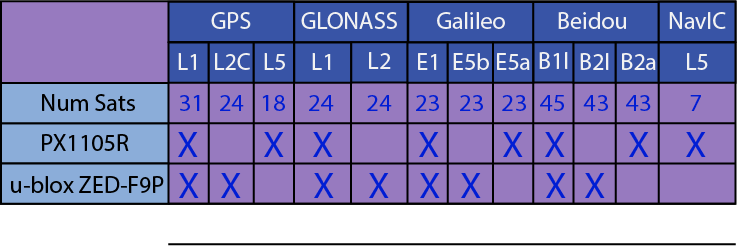
First, an important element of RTK performance is the number of satellites that are going to be visible at any given time. Having more available satellites allows faster and more robust RTK solutions, as well as permitting solutions where portions of the sky are blocked. Below is a table with the bands supported by each receiver as well as the approximate number of satellites that use each band, note that NavIC is a regional system operated by India.
The u-blox ZED-F9P covers the L1 and L2 bands while the PX1105R covers the L1 and L5 bands, with similar numbers of satellites.
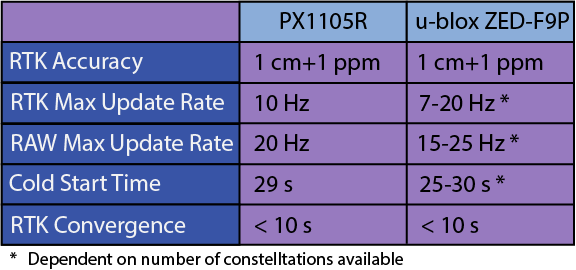
Some additional important specs for the three receivers are in the table below. The three receivers have comparable RTK accuracy, update rates, and cold start/RTK convergence times.
Full data sheets for the three receivers are available: